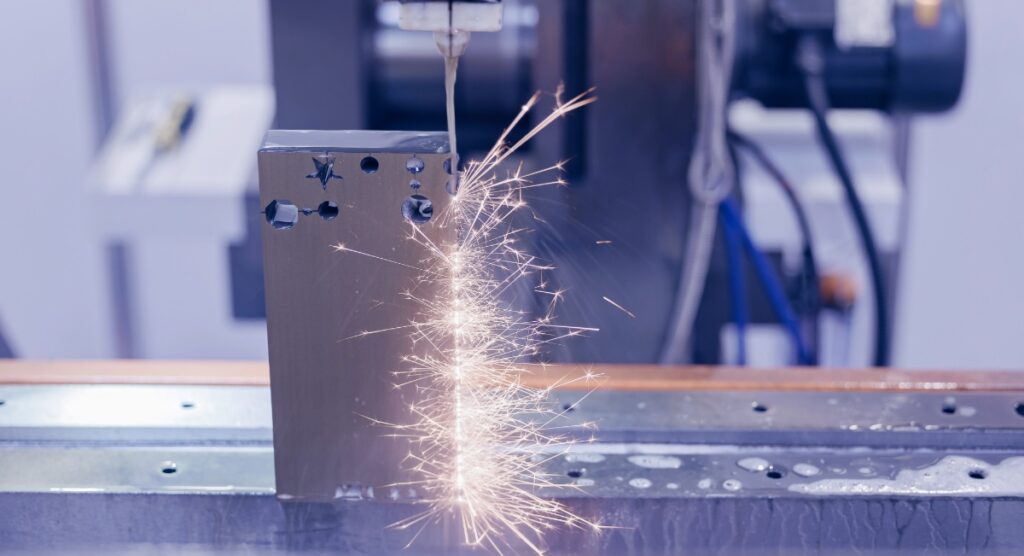
Because it is electrically conductive, wire EDM can be used to cut aluminum. The process is often useful when an aluminum part needs clean profiles, sharp internal features, narrow openings, or accurate geometry without heavy cutting pressure.
In practice, EDM (electrical discharge machining) makes the most sense when one feature controls how the aluminum component fits, moves, seals, or repeats. That is where aluminum can overlap with wire EDM parts: not every aluminum job needs EDM, but one critical detail may justify the process.
In this article:
- Why aluminum can be a good fit for wire EDM.
- What makes aluminum different in wire EDM work.
- Industry use cases for aluminum wire EDM parts.
- What to know before quoting aluminum wire EDM parts.
- What happens after aluminum is cut with wire EDM.
- Answers to FAQs about wire EDM aluminum.
If you need help evaluating an aluminum part for EDM, contact Roberson Machine Company or call 573-646-3996 to discuss the material, quantities, and production requirements.
Why Aluminum Can Be a Good Fit for Wire EDM
Aluminum is often chosen for machined parts because it offers a useful mix of low weight, conductivity, workability, corrosion resistance, and production value. When an aluminum part also needs a feature that is difficult to cut cleanly with standard tooling, wire EDM may become part of the machining path.
Low weight with practical strength
Aluminum is commonly used when a part needs to reduce weight while still maintaining a useful strength-to-weight ratio in the assembly, fixture, housing, bracket, or production environment.
Wire EDM can help when that lighter component also needs a controlled cut that affects fit, location, or function.
Conductive material for EDM cutting
Wire EDM requires electrically conductive material, which is why aluminum can be cut with the process. The EDM decision usually comes down to the finished feature, production need, and whether EDM adds value compared with milling, drilling, turning, or another CNC method.
- Useful when an aluminum part has feature-critical geometry
- Better suited for controlled details than broad material removal
- Often evaluated alongside other CNC machining methods
Workability for detailed part designs
Aluminum is known for being workable and relatively malleable, which makes it useful across many machined part designs. Wire EDM can still make sense when the finished detail requires controlled geometry that standard tooling cannot produce as cleanly.
Production value for repeat parts
Aluminum can be a practical material choice for repeat production when the part design, quantity, and machining path are clear.
- The material is already specified for weight, handling, or performance reasons.
- The EDM-cut detail needs to repeat accurately across future orders.
- The part may also need milling, drilling, turning, or inspection before it is complete.
What Makes Aluminum Different in Wire EDM Work?
Aluminum can be cut with wire EDM, but it does not behave exactly like tool steel, stainless steel, carbide, or other conductive materials. It is lightweight, workable, conductive, and often selected for production reasons before EDM is ever considered.
That means the EDM decision usually comes down to the finished part requirement. The shop has to look at the alloy, material thickness, feature shape, tolerance needs, finish requirements, and whether another CNC process should handle most of the work before EDM finishes the critical detail.
When Wire EDM Makes Sense for Aluminum Parts
Wire EDM is practical when an aluminum part has a feature that standard milling, drilling, turning, or another CNC process cannot produce cleanly on its own. The part may still move through other machining steps, but EDM can handle the detail that needs better access, lower cutting pressure, or tighter control.
- The alloy and thickness fit the process: Different aluminum alloys and material thicknesses can affect how the EDM work should be planned.
- The feature affects the finished part: The EDM-cut detail should affect fit, movement, locating, clearance, or another functional part requirement.
- The part needs more than broad material removal: EDM usually makes more sense for controlled details than for removing large amounts of aluminum.
- The job may repeat later: If the same aluminum part will come back, EDM should fit a process that can be repeated without re-solving the job each time.
Industry Use Cases for Aluminum Wire EDM Parts
Aluminum wire EDM work appears across industries where lightweight, conductive, or production-friendly parts need one controlled EDM-cut detail to fit, function, or repeat correctly. Common use cases include:
- Aerospace and military manufacturing components: Aluminum parts used in weight-sensitive assemblies, brackets, housings, tooling, and support components may need EDM-cut details when fit or alignment matters.
- Automation and robotics parts: Fixtures, end-of-arm tooling, lightweight housings, and motion-related components may use aluminum to reduce weight while still requiring controlled features.
- Electronics and conductive components: Aluminum can be used for parts where conductivity, heat transfer, or lightweight construction matters, especially when the finished design includes detailed internal geometry.
- Packaging and production equipment: Aluminum tooling, guides, plates, and support parts may need repeatable features that help production equipment locate, move, or inspect parts consistently.
- Prototyping and production transition work: Aluminum is often useful when a part is moving from early validation into repeat production and the critical feature needs to stay consistent across future orders.
Wire EDM may handle the critical detail, but many aluminum parts still need other machining steps. Roberson Machine Company can also support aluminum CNC machining, 5-axis machining, CNC milling, CNC turning, and precision CNC machining.
What to Know Before Quoting Aluminum Wire EDM Parts
Quoting aluminum wire EDM work gets easier when the shop can see how the material, part geometry, quantity, and production requirements fit together. The drawing or model should make clear which detail needs EDM, which dimensions matter most, and whether the part also needs milling, drilling, turning, inspection, or finishing.
Aluminum alloy and material condition
Different aluminum alloys can affect strength, machinability, finish requirements, and how the part should move through the larger machining process. Material thickness and stock condition also matter before the EDM path is planned.
The EDM-cut feature
Call out the feature that needs wire EDM and explain what it controls. A profile, opening, internal detail, or thin section may affect fit, movement, locating, clearance, or repeatability in the finished part.
Quantity and repeat demand
A one-time aluminum part and a recurring production order may need different planning. Quantity, release timing, and future demand help determine whether the EDM work should be treated as a one-time feature or part of a repeatable process.
Tolerances, inspection, and finish
Tight dimensions, inspection requirements, surface finish needs, and finishing steps should be clear before quoting. Those details help determine how EDM fits into the full aluminum machining path.
What Happens After Aluminum Is Cut With Wire EDM?
After aluminum is cut with wire EDM, the part may still need milling, drilling, deburring, finishing, inspection, or assembly. The EDM cut may create the critical detail, but the full part still has to meet the print and work in its final application.
Before the job moves forward, it helps to review:
- How the EDM-cut detail affects fit, function, movement, or assembly.
- Whether other machining should happen before or after wire EDM.
- What inspection, surface finish, or documentation requirements apply.
- Whether the same aluminum component may need to repeat in future orders.
FAQs About Wire EDM and Aluminum
Most questions about wire EDM and aluminum come down to material fit, part geometry, and whether EDM belongs in the larger machining path. These FAQs cover common questions before quoting or producing aluminum parts with EDM-cut details.
Can aluminum be cut with wire EDM?
Aluminum can be cut with wire EDM because it is electrically conductive. The process can help when an aluminum part needs a controlled cut, detailed feature, or low-force machining approach.
The better question is usually whether wire EDM adds value for the specific part. Many aluminum parts still belong primarily to milling, drilling, turning, or other CNC machining methods.
When does wire EDM make sense for aluminum parts?
Wire EDM makes sense when one feature is difficult to make cleanly with standard tooling alone. That may involve a thin section, internal form, tight access point, or part detail that affects fit, movement, assembly, or repeatability.
The part may still need other machining before or after EDM. Wire EDM is often the process used for the detail that needs the most controlled cut.
Is wire EDM always the best process for aluminum?
Wire EDM is one option for aluminum, but it is not always the best process. If the part mostly needs broad material removal, pockets, simple holes, turned diameters, or open features with easy tool access, another CNC machining method may be more practical.
Wire EDM is most useful when the aluminum part has a feature that benefits from EDM-level access, low cutting pressure, or controlled geometry.
What should I send when quoting aluminum wire EDM parts?
A print, CAD file, or sample part is the best starting point. Material grade, thickness, quantity, tolerances, inspection needs, and any finishing requirements also help define the machining path.
Helpful quoting details include:
- Aluminum alloy and stock condition
- Critical dimensions and feature callouts
- Quantity and expected repeat demand
- Other required machining steps
- Inspection, surface finish, or documentation requirements
Can aluminum wire EDM parts be used for repeat production?
Aluminum wire EDM parts can support repeat production when the material, drawing, feature requirements, and quantities are clear. This is especially useful when the same EDM-cut detail needs to come back consistently across future orders.
Repeat work becomes easier to manage when the first order is planned around the full part, not just the EDM cut.
Work With Roberson Machine Company for Aluminum Wire EDM Parts
Aluminum wire EDM work should support the way the finished component needs to fit, function, and move through production.
- Review the aluminum alloy, print, feature requirements, and quantities before production begins.
- Determine whether wire EDM, aluminum CNC machining, or both processes fit the part.
- Plan critical details around future orders, replacement needs, and production changes.
If you are evaluating an aluminum part for wire EDM, contact our team or call 573-646-3996 to talk through the material, quantities, and next steps.