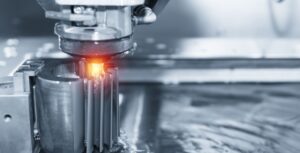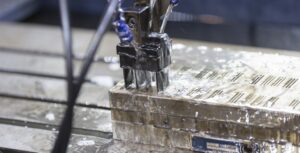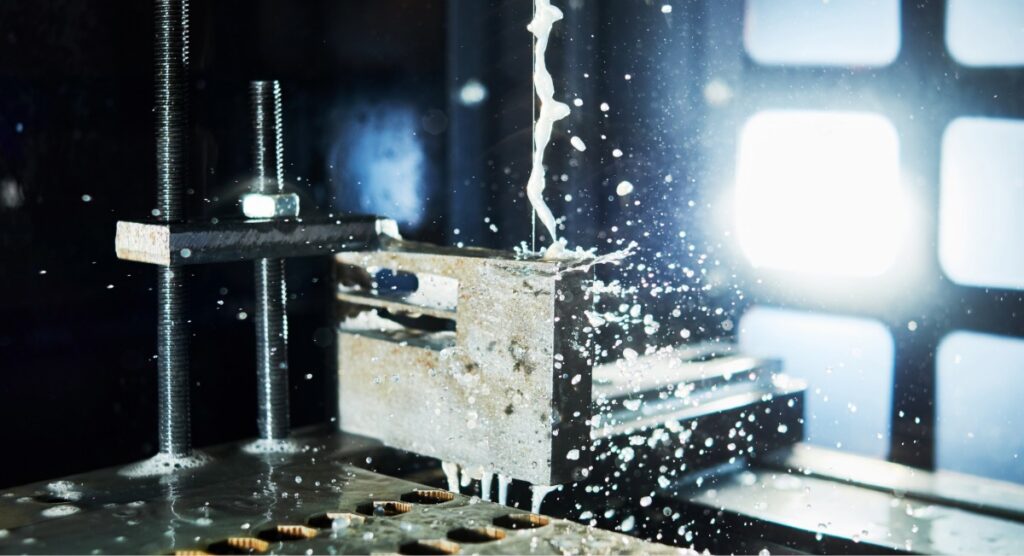
Wire EDM fits into bulk production when the same critical feature has to repeat cleanly from one part to the next. That may be a slot, keyway, cutout, internal profile, or hardened detail that drives how the part fits or functions.
When manufacturers need wire EDM parts across repeat orders or high-volume production schedules, the process has to do more than cut the feature once. It has to support the same part coming back again.
In this article:
- When wire EDM fits bulk production
- What parts and features are often machined with wire EDM
- What manufacturers should plan before repeat wire EDM orders
- FAQs about wire EDM for bulk production
If you are preparing a repeat or high-volume part with EDM-cut features, contact Roberson Machine Company or call 573-646-3996 to discuss the material, quantities, and production requirements.
When Wire EDM Fits Bulk Production
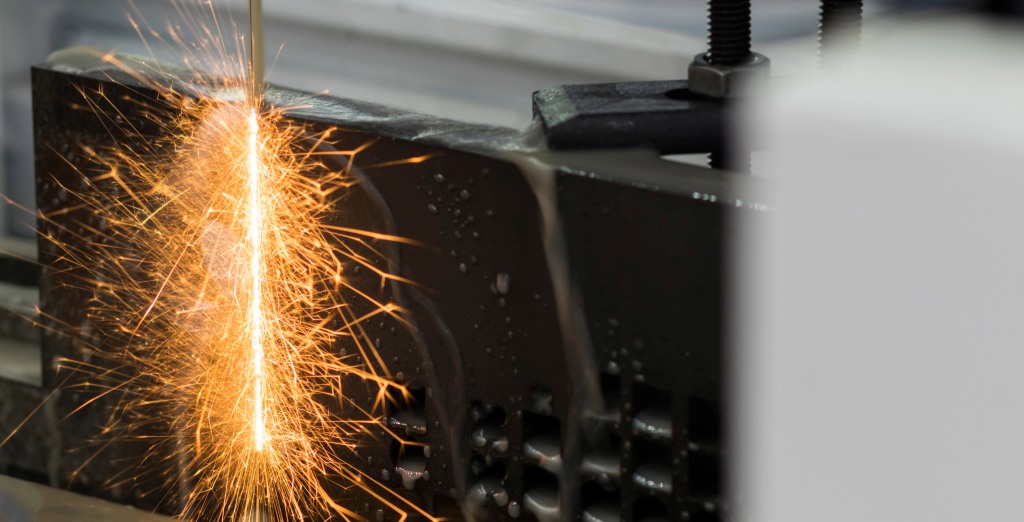
Wire EDM (electrical discharge machining) fits bulk production when the EDM work is tied to a repeatable requirement, not just a one-time difficult cut. The part should have a defined feature, stable material requirements, known quantities, and a production path where using EDM helps keep the finished component consistent from order to order.
Bulk production has the same basic problem as everyday machinery components ordered by the thousands: a small process problem does not stay small once the order repeats. If the same critical detail is wrong across a production run, the issue follows every part downstream.
Where bulk production pressure shows up
Wire EDM becomes more relevant when the same difficult feature has to stay consistent across larger orders, future releases, or replacement schedules.
- The order volume is increasing: A feature that is manageable on one part can become expensive when the same issue repeats across hundreds or thousands of components.
- The part has to support downstream work: Production tooling, inspection parts, and assembly-related components need features that help the next step happen correctly.
- The material condition is already set: If heat treat, hardness, or material preparation happens before the final feature is cut, the production path has to account for that sequence.
- The job is expected to return: Recurring orders benefit from a process that can be repeated without re-solving the part from scratch every time.
Parts and Features Often Machined With Wire EDM
In bulk production, wire EDM usually shows up when a repeat order depends on a feature that is hard to cut cleanly with standard tooling. The part itself may be simple or complex, but the EDM-cut detail has to stay consistent across the run.
Common examples include:
- Keyways and shaped openings where fit, clearance, or motion depends on a clean internal form.
- Internal profiles and through-cuts that need to carry accurately through conductive material.
- Sharp inside corners that would be difficult to produce with a rotating cutting tool.
- Tooling inserts, dies, and gauges where one small detail can affect downstream production.
- Hardened or heat-treated details that need final profile work after material preparation.
- Thin or delicate sections that could move, flex, or distort under conventional cutting pressure.
What Parts Do Not Usually Need Wire EDM?
Not every bulk production part needs wire EDM. If the feature can be made cleanly with milling, turning, drilling, or another standard machining process, EDM may add cost or complexity without improving the finished part.
Wire EDM may not be the right fit when the job mostly involves:
- Flat faces, pockets, or mounting surfaces that CNC milling can handle efficiently
- Round diameters, bores, shoulders, or threads suited for CNC turning
- Simple drilled holes or open features with easy tool access
- Broad material removal instead of narrow slots, profiles, or internal cutouts
- Non-conductive materials that cannot be cut with EDM
In those cases, the better path may involve CNC milling, CNC turning, 5-axis machining, or multi-axis machining before wire EDM ever enters the conversation.
For bulk production, the goal is not to use wire EDM everywhere. The goal is to use it where the EDM-cut feature protects the part’s fit, function, repeatability, or production value.
What Manufacturers Should Plan Before Repeat Wire EDM Orders
Repeat wire EDM work gets easier when the important details are clear before the job is quoted or released. The shop needs to understand the part geometry, material, quantity, tolerances, inspection requirements, and whether the same part is expected to be reordered.
Current and future quantities
Plan for how many parts are needed now, how often the order may return, and whether release schedules are likely to change. Repeat work is easier to quote and schedule when volume expectations are clear early.
Critical EDM-cut features
Identify the features that control how the part fits, moves, locates, or performs. Those details are usually what determine whether EDM belongs in the production path.
Material and condition
Clarify whether the part will be cut from prepared stock, hardened material, stainless steel, aluminum, tool steel, carbide, or another conductive material. Material condition can affect both the EDM work and the larger production path.
Tolerances and inspection needs
Call out which dimensions need the closest control and whether the part requires inspection reports, documentation, or special handling. Repeat orders depend on knowing which details cannot drift.
Other production steps
Note whether milling, turning, drilling, heat treat, finishing, or assembly requirements affect when EDM should happen. For repeat work, the EDM cut has to fit the full production path, not just the drawing.
The more repeat work depends on one critical feature, the more important it becomes to plan that feature around the full production path instead of treating it as a one-time cut.
FAQs About Wire EDM for Bulk Production
Most questions about wire EDM and bulk production come down to repeatability, planning, and whether EDM belongs in the larger machining path. These FAQs cover common production questions before sending repeat work to a machine shop.
Can wire EDM be used for bulk production?
Wire EDM can be used for bulk production when the EDM-cut feature is part of a repeatable machining path. The part may still need milling, turning, drilling, heat treat, inspection, or other production steps, but EDM can handle the feature that needs clean access, low-force cutting, or consistent detail from part to part.
It makes the most sense when the same critical detail has to come back consistently across repeat orders.
What makes repeat wire EDM work easier to quote?
Repeat wire EDM work is easier to quote when the shop can see the part geometry, material, quantity, tolerances, inspection needs, and expected release schedule. A CAD file or part blueprint helps define which features need EDM and which features belong to other machining steps.
Helpful details include:
- Current quantity and likely future order volume
- Material type, thickness, and condition
- Critical EDM-cut features and tolerance callouts
- Inspection, finishing, or documentation requirements
- Any timing needs tied to production releases
Does every repeat production part need wire EDM?
Not every repeat production part needs wire EDM. If the part mostly involves flat faces, pockets, mounting surfaces, round diameters, bores, threads, or simple drilled holes, another machining method may be the better fit.
Wire EDM is most useful when the repeat part depends on a feature that standard tooling cannot cut cleanly or consistently enough. For bulk production, the goal is not to add EDM everywhere. It is to use EDM where the feature protects fit, function, repeatability, or production value.
How does wire EDM help when the same part comes back later?
Wire EDM helps when the same part comes back later because the critical feature can be planned around a repeatable process instead of treated like a one-time cut. That matters for replacement parts, tooling details, production support components, and orders that return on a schedule.
When the material, drawing, quantity, and feature requirements stay clear, the shop has a better path for keeping the same part consistent across future orders.
Why Repeat Wire EDM Work Comes Back to the Right Process
By this point, the pattern is pretty clear. Wire EDM keeps showing up in repeat production when one difficult feature has to stay consistent across bulk orders, future releases, or replacement needs.
- Critical EDM-cut features get planned around the production path instead of treated as one-off problems.
- Repeat parts get easier to manage when the requirements stay clear from one order to the next.
- Parts that need to fit, locate, move, or support downstream production have a cleaner path when EDM is used where it actually adds value.
If you are evaluating a part for bulk production or repeat EDM work, contact our team or call 573-646-3996 to talk through the material, quantities, and next steps.