A successful production run for a single part doesn’t mean much if that run can’t be supported over time with contract manufacturing. The value of this model shows up when production has to hold together across repeat orders—while accommodating shifts in demand, available equipment, and scheduling constraints.
That stability doesn’t come from a single machine or service. It comes from the machining solutions, processes, and capacity decisions that sit behind contract manufacturing and determine whether production stays on track or starts to unravel.
- Machining capabilities that support ongoing contract manufacturing
- How process control keeps production stable across repeat releases
- How machining solutions are applied in real contract manufacturing programs
If you’re evaluating how machining solutions support contract manufacturing in your production workflow, you can call 573-646-3996 or contact Roberson Machine Company to talk through scope, timing, and execution. We’ll help determine how machining decisions should support the work as it moves into ongoing production.
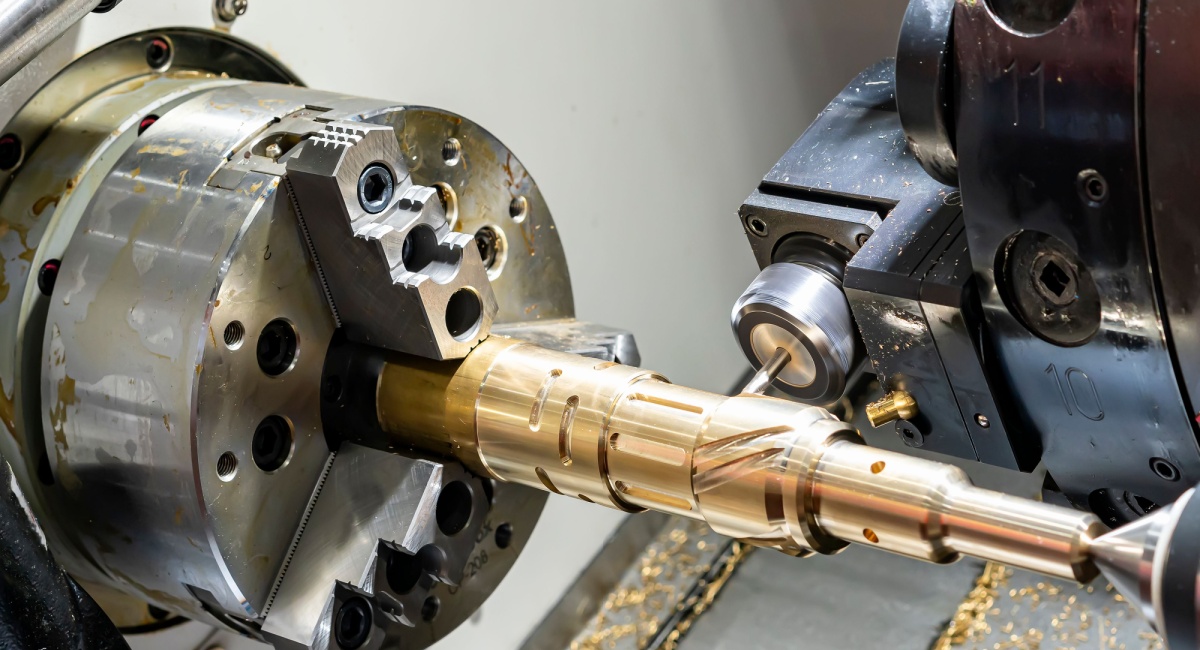
Machining Capabilities That Support Ongoing Production
Not every machining capability supports contract manufacturing equally. When production work repeats, the value of a capability isn’t measured by how impressive it looks on a spec sheet—it’s measured by how consistently it performs across releases.
At Roberson Machine Company, contract manufacturing programs draw from machining capabilities selected to reduce variation, limit setup changes, and keep production behavior predictable as schedules and demand shift, including:
- CNC Turning and lathe-based workflows that keep rotational geometry consistent across releases
- CNC Milling for multi-feature parts that need to arrive built the same way every order
- Precision CNC Machining where dimensional control has to hold up over time, not just once
- 5-Axis CNC Machining and Multi-Axis CNC Machining to reduce setups and limit variation between runs
- Wire EDM for precision features or hardened materials within a larger production workflow
- Stainless Steel CNC Machining and Aluminum CNC Machining to support repeat production across common materials
- Prototype CNC Machining when early production work needs to transition cleanly into ongoing releases
Individually, these capabilities solve specific machining challenges. Together, they support contract manufacturing programs by keeping production stable as work repeats, volumes shift, and requirements evolve.
How These Capabilities Show Up in Real Production
The machining capabilities that support contract manufacturing don’t exist in a vacuum. They’re applied every day in production environments where parts need to arrive built the same way across releases, schedules matter, and downstream systems depend on consistency.
These capabilities support contract manufacturing programs across industries like aerospace, automotive and heavy machinery, medical and pharmaceutical, food and beverage, oil and energy, and other production-driven industries where output has to hold up over time.
In contract manufacturing environments, these capabilities most often support parts that sit inside larger systems and continue cycling long after the first release. The focus isn’t on novelty—it’s on components that have to keep behaving the same way as production continues.
- Motion and drive components such as shafts, pins, bushings, and drive-shaft assemblies that transfer load and alignment across equipment
- Rotational and conveying elements including rollers and cylindrical tooling used in packaging, printing, and material handling systems, such as long-running ink rollers
- Fluid-handling and pressure components like valve bodies, manifolds, and pump housings built to seal reliably in medical, hydraulic, and energy applications
- Protective and structural housings that maintain alignment and protect sensors, motors, and instrumentation across repeat installations
- Hybrid mechanical components such as couplings, small manifolds, and end-of-arm tooling that combine turned geometry with milled features
- Precision instrumentation and medical hardware including valve bodies and acrylic instrument components where repeat builds need to behave consistently in real use
These are components that wear, seal, align, and transfer motion inside active systems. Contract manufacturing exists to keep this kind of production work stable as demand repeats and operating conditions stay unforgiving.
Process Control & Production Stability
In contract manufacturing, machining capability alone doesn’t keep production from breaking down. Stability lives in how the work is executed once it starts repeating—not in how advanced a machine looks on paper.
In practice, process control means defining how the part is built, inspected, and released—and keeping that execution consistent as orders repeat.
Most production problems don’t start at the machine. They show up between releases, when execution starts drifting:
- Setups change slightly from run to run
- Inspection expectations get reinterpreted
- Process knowledge lives in people instead of documentation
- Every reorder feels like starting over
Production stays stable when those variables are removed. Locked setups, defined inspection routines, and documented workflows keep the work behaving the same way as orders repeat—even when schedules and volumes change.
When execution is treated like a system instead of a series of jobs, repeat orders move with fewer resets. Revisions can be absorbed without restarting the process or wasting materials. Schedules become easier to protect because the workflow doesn’t change every time demand shifts.
This is where contract manufacturing stops feeling like coordination overhead and starts functioning as an extension of internal production. The goal isn’t better machines—it’s fewer surprises as work continues.
Applying Machining Solutions to Contract Manufacturing Programs
Machining solutions support contract manufacturing when they’re applied with a clear understanding of how production behaves once work starts repeating. The goal isn’t adding more capability—it’s reducing the friction that shows up between releases.
This is typically where teams responsible for output, schedules, and production continuity start looking for outside support:
- Production schedules are tightening, but internal capacity is already spoken for
- Repeat work keeps pulling the same people back into setup and inspection conversations
- Output matters more than experimentation, and consistency matters more than optimization
- Production needs to stay predictable without reshuffling internal priorities
For operations managers, manufacturing leads, and engineering teams, those pressures change how machining decisions get made. The right capabilities—applied the right way—can stabilize production without forcing teams to give up control over requirements, quality expectations, or release timing.
At Roberson Machine Company, we work directly with operations, engineering, and manufacturing teams to align machining execution with how work actually runs in ongoing contract manufacturing programs.
If you’re looking to tighten execution inside a repeat-production environment, reach out to our team or call 573-646-3996 to talk through where machining solutions can better support your production workflow.