CNC milling and robotics work together to make production more efficient by reducing the manual handling required between machining cycles. Repeat production benefits most when the same loading, unloading, and part-transfer steps occur across many parts.
For manufacturers using an automated CNC milling machine, robotic systems can connect the milling cycle with loading, unloading, and the next production step instead of treating each completed part as a manual reset.
In this article:
- How robotic CNC milling works
- What robots do in a CNC milling process
- What CNC robotic milling services include
- How robotic milling affects production time and consistency
- Answers to common questions about CNC robotic milling services
How Does Robotic CNC Milling Work?
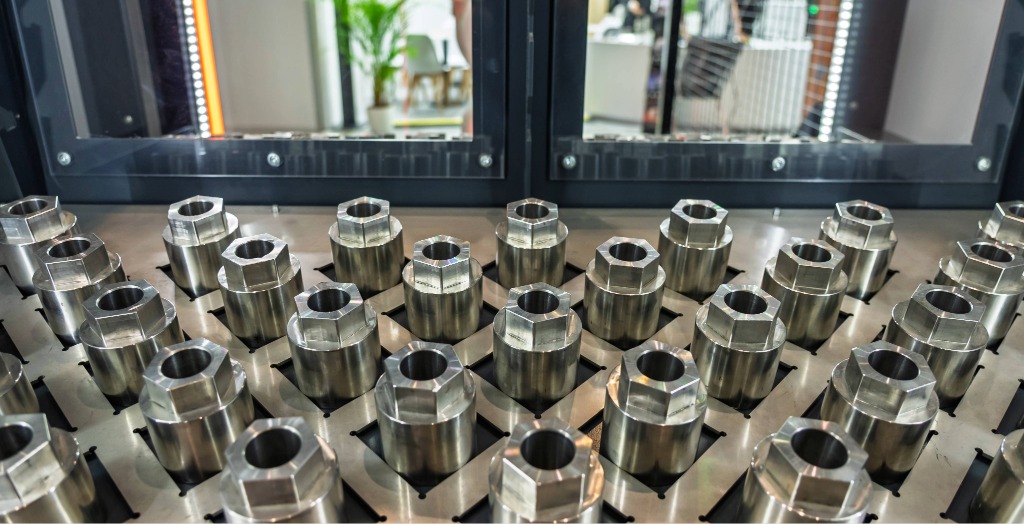
Robotic CNC milling works by coordinating a CNC mill with robotic equipment that handles repeatable steps before or after the machining cycle. The machinist establishes the program, tooling, workholding, and process requirements, while the robot follows a defined sequence for moving parts through production.
- The next part is staged: Raw material or a prepared workpiece is placed where the robotic system can access it.
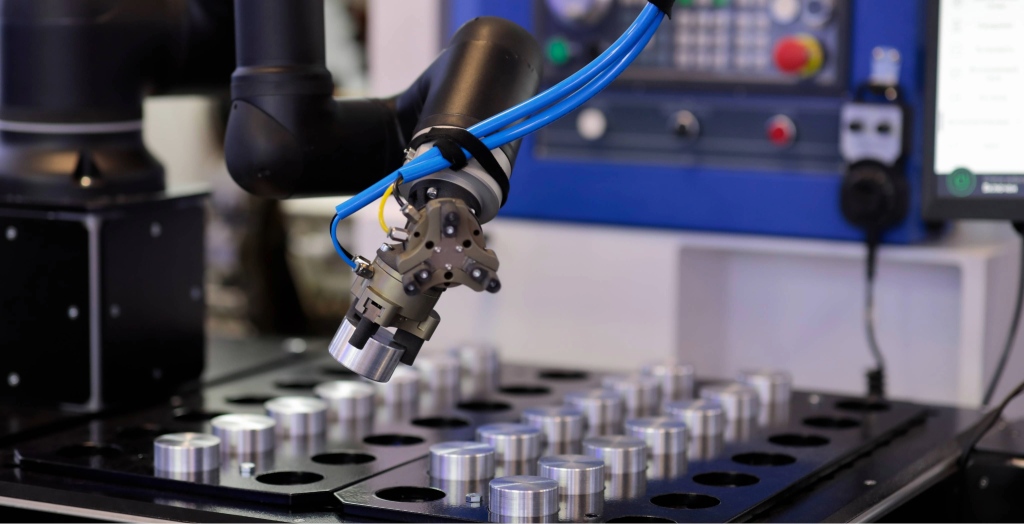
- The robot loads the machine: The workpiece is positioned in the fixture or workholding system for machining.
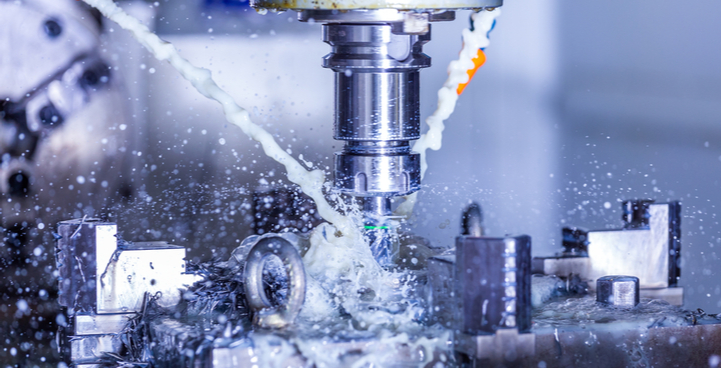
- The CNC mill runs the programmed cycle: Cutting operations proceed according to the established machining program.
- The robot removes the finished part: The completed workpiece moves to inspection, another operation, or a finished-part staging area before the next cycle begins.
Once that sequence is established, the next machining cycle can begin with less routine operator handling between parts.
What Do Robots Do in CNC Milling?
Robots support CNC milling by loading and unloading parts, positioning workpieces, transferring components, and linking repeatable steps around the machining cycle. The CNC mill performs the cutting while the robotic system manages defined material movement between cycles or operations.
Load and Unload the Machine
Robotic machine tending places raw or partially machined parts into the mill and removes them after the programmed cycle finishes.
Position Workpieces Consistently
Robotic systems present parts in a defined orientation before machining or another operation begins.
Move Parts Between Operations
Robots transfer workpieces between machines, fixtures, inspection stations, and other production steps without repeating the same manual move each cycle.
Support Connected Production Cells
Larger automated cells coordinate milling with inspection, washing, deburring, or other repeatable operations as part of one production process.
What Do CNC Robotic Milling Services Include?
CNC robotic milling services combine machining, programming, workholding, robotic handling, and inspection within one repeatable production process. Each part of that process has to work together so automation does not simply move a bottleneck somewhere else.
Before production: The machining sequence, tooling, fixtures, robot movements, and inspection requirements are planned around the part and production run.
During production: The CNC mill performs the programmed cutting while robotic equipment handles defined loading, unloading, positioning, or transfer steps.
After machining: Finished parts move into inspection or the next required operation, while inspection results and production conditions guide any needed process adjustments.
How Does Robotic Milling Affect Production Time and Consistency?
Robotic milling reduces time spent handling parts between machining cycles and makes repeated loading, positioning, and transfer steps more consistent across a production run. The CNC mill still performs the cutting, while robotics reduces variation and delays in the work surrounding each cycle.
| Production Area | Effect of Robotic Milling |
|---|---|
| Machine idle time | Automated loading and unloading reduce waiting between completed parts and the start of the next machining cycle. |
| Handling consistency | The same programmed movements repeat from part to part instead of changing with each manual load or transfer. |
| Part positioning | Workpieces enter the fixture in a defined orientation as part of the established loading sequence. |
| Production windows | Stable jobs continue through more of the available production period without requiring an operator to handle every cycle change. |
| Operator time | Machinists spend less time repeating part movement and more time managing setup, tooling, inspection, and process changes. |
Consistent robotic handling does not replace the factors that control machining accuracy. Programming, tooling, workholding, machine condition, and inspection still determine how consistently finished parts meet their requirements.
FAQs About CNC Robotic Milling Services
How expensive are CNC robotic milling services?
The cost depends on the part, machining time, workholding, programming, inspection requirements, production volume, and automation required for the job. Robotic handling may add setup time, but repeat production distributes that setup across more parts while reducing repeated manual handling between cycles.
Is robotic CNC milling mainly used for bulk production?
Robotic CNC milling is especially useful when the same machining and handling steps repeat across larger production runs. That makes it a natural fit for high-volume CNC milling and other forms of bulk part production, where reducing repeated loading and unloading has more time to pay off across the run.
Where Do Robotics and Automation Fit Into CNC Machining?
Robotics and automation support several CNC machining processes when loading, positioning, transfer, or other production steps repeat consistently.
- CNC Milling: Automate part loading, unloading, positioning, and transfer around the milling cycle
- Precision CNC Machining: Support repeat production where consistent handling and inspection matter across the run
- Multi-Axis Machining: Coordinate more complex machining with repeatable part handling and positioning
- 5-Axis Machining: Combine complex cutting with automated handling when the production process supports it
Does the robot perform the milling?
In the type of robotic CNC milling described here, the CNC mill performs the cutting. The robotic system supports the machining process by loading, unloading, positioning, transferring, or staging parts around the machine.
Can robotic milling be used for custom parts?
Yes, but automation becomes more useful as the part and process become repeatable. A custom component that returns in recurring production runs may be a better fit than a one-off part that requires a completely different setup each time.
Plan Your Next Automated Milling Project
Robotic milling works best when the machining process and the automated handling around it are planned as one production system. Roberson Machine Company can review the part, volume, tolerances, workholding, and repeat-order requirements to determine how automation fits into the machining plan.
Start With the Part and Production Run
Part geometry, order volume, tolerances, and required handling help define where robotic movement supports the milling process.
Coordinate Machining and Material Movement
Programming, tooling, workholding, loading, unloading, and inspection need to function together so automation keeps production moving instead of creating another bottleneck.
Build Around Repeatable Production
Established programs, fixtures, handling routines, and inspection requirements give recurring parts a consistent path through future production runs.
Request a quote or call 573-646-3996 to discuss your next CNC milling project.